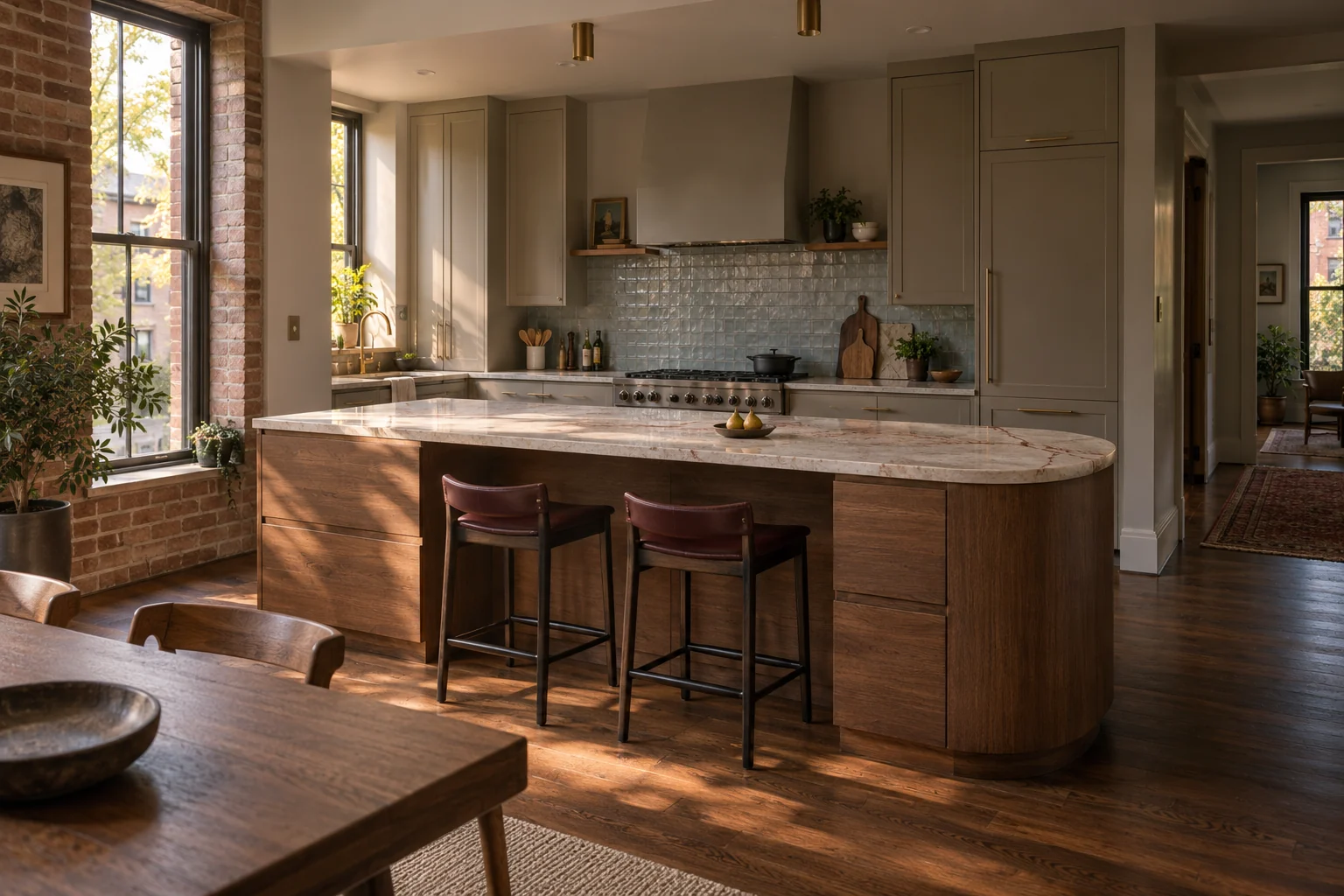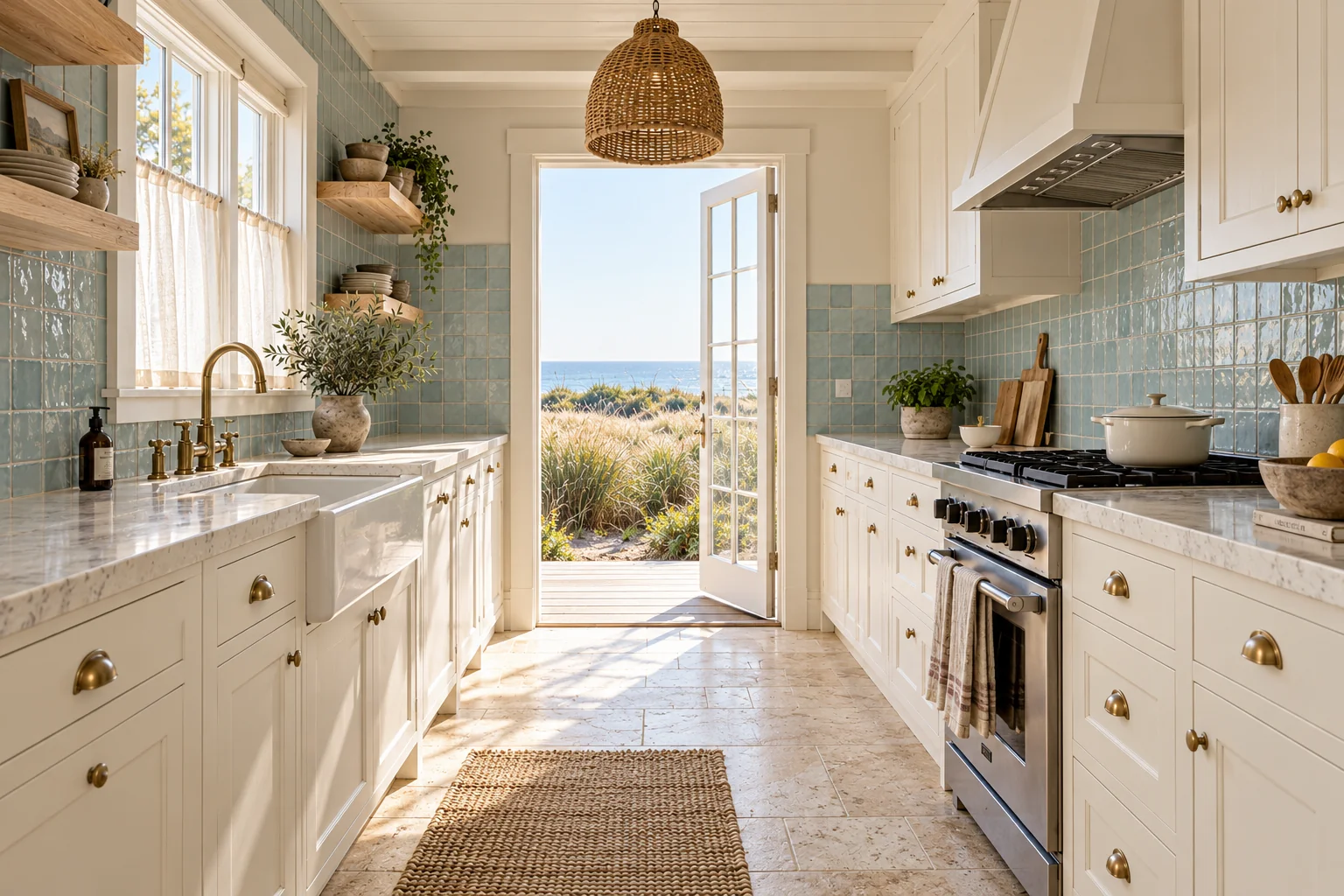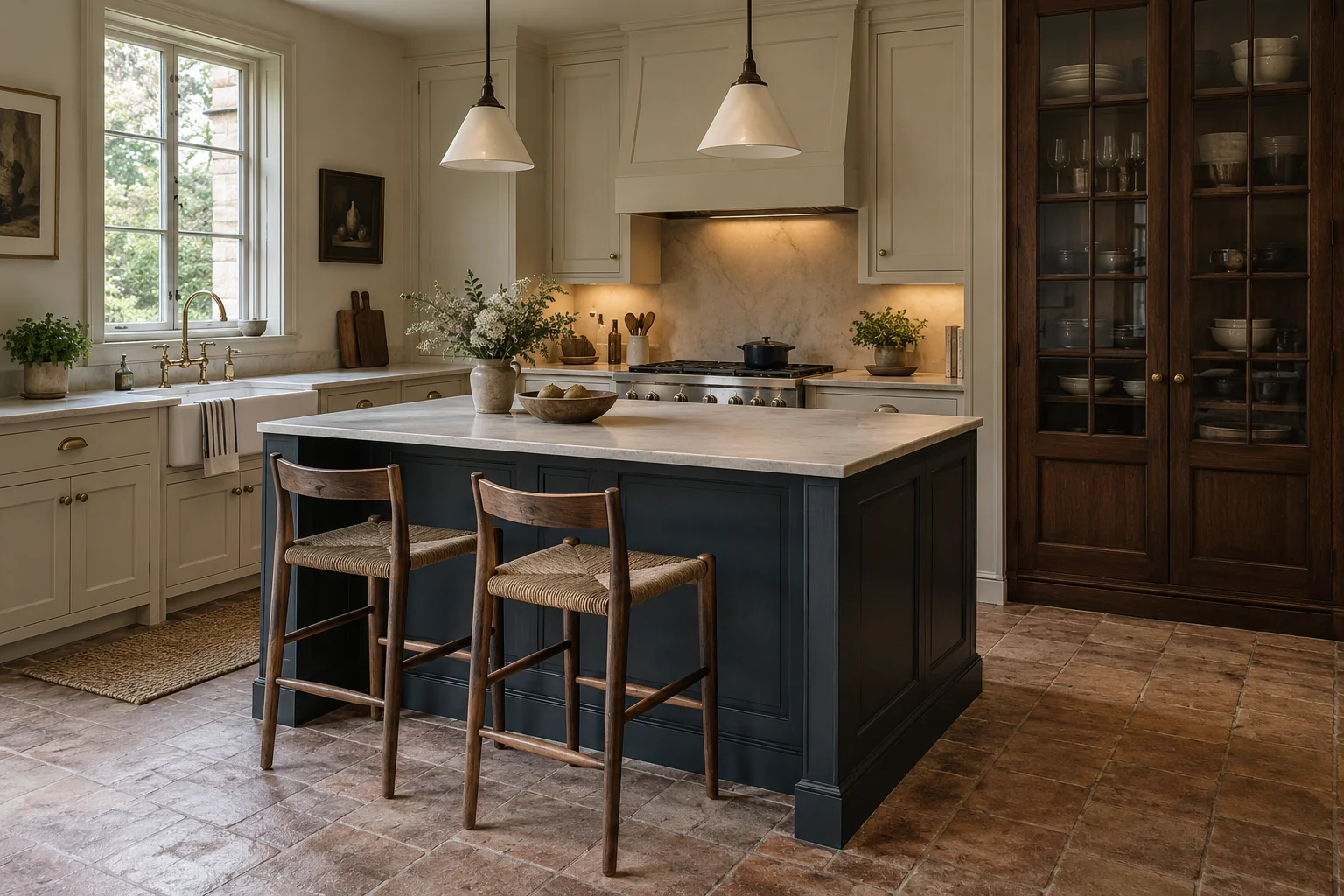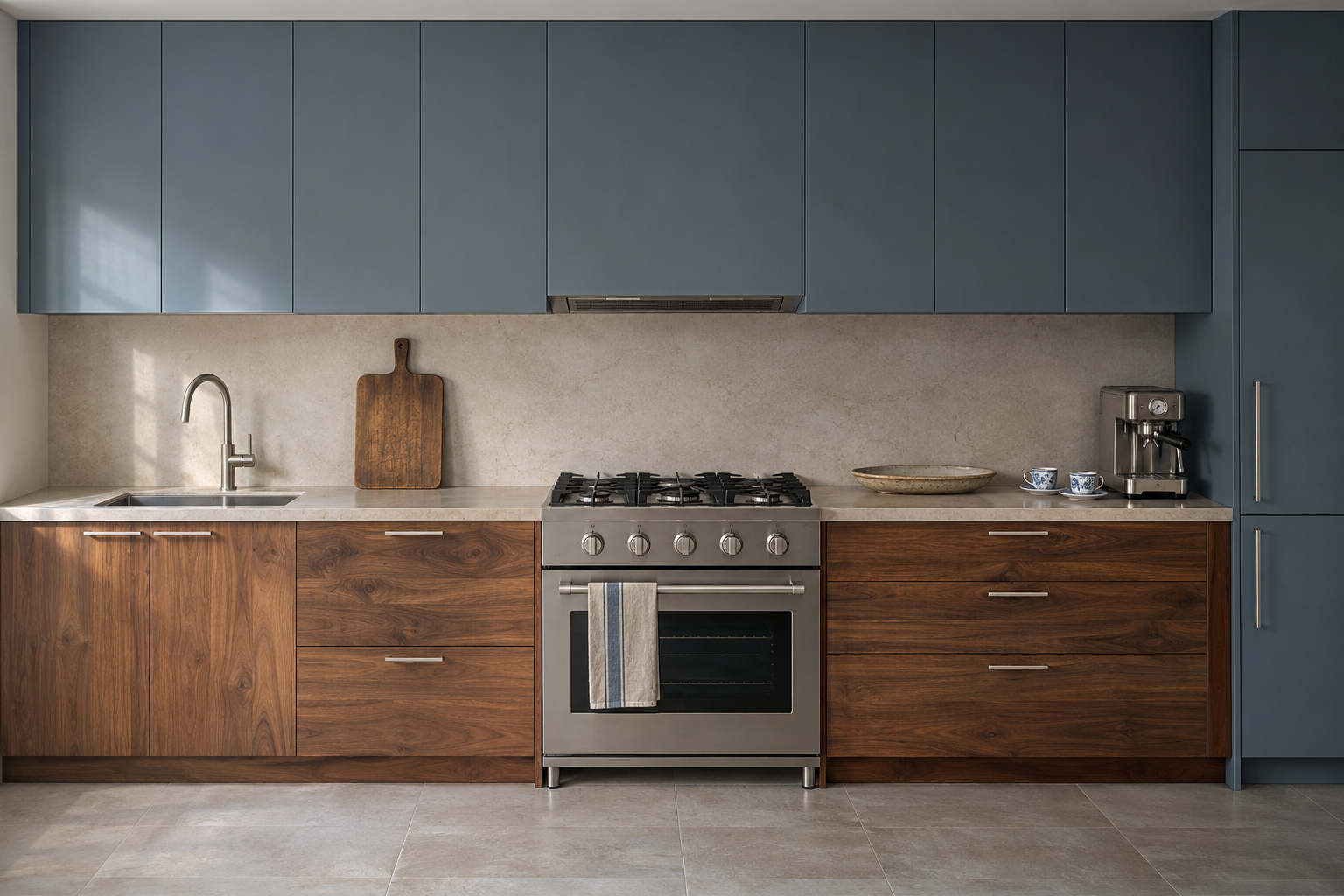
Choose wood kitchen cabinets by the amount of grain you want to see across the room, then judge the finish beside your floor and countertop. A little oak sample can be irresistible. Give that same grain an entire wall and it has rather more to say.
The decisions become easier when you make them in order: where the wood belongs, how expressive it should be, and what will sit beside it. Start by putting the sample down and looking at the room.
Natural wood kitchen cabinets: decide where the wood should stop
Look from the kitchen entrance and any adjoining living space. The view might already contain a timber floor, a dining table and wooden ceiling beams. Your cabinets are joining that conversation.
If the room feels busy, concentrate the wood in one clear area: the lower cabinets, a tall pantry run or the island. Painted cabinets elsewhere can give the grain breathing room while retaining the storage you need.
Architect Julie Campbell of CTA Design Builders took this approach in a Seattle kitchen reported by Houzz. Walnut linked the lower cabinetry and window bench; white upper cabinets kept the top of the room lighter.
An all wood kitchen can be beautiful too. Keep the door shapes consistent and give the eye somewhere calmer to land, perhaps a plain backsplash or painted ceiling. If an island alone would provide enough warmth, our kitchen island ideas explore its shape and material choices.
With the area of wood settled, look closer at the grain.
White oak or walnut kitchen cabinets? Look beyond the color
Two fronts can share a similar brown and still give a kitchen entirely different personalities. One has quiet, straight lines. The other has sweeping curves that become the room’s main pattern.
White oak kitchen cabinets: compare the cut
Ask to see different cuts as well as different stains. Plain sawn oak often has broad, arched grain; quartersawn oak can show distinctive flecks. KraftMaid’s oak guide illustrates how the appearance varies.
For a more linear effect, ask the cabinetmaker about rift cut oak. Specify the look on several adjacent fronts, because “white oak” alone does not promise one color or grain pattern.

Walnut kitchen cabinets: give the grain room
Walnut makes a compelling choice when you want depth without painting the cabinets. Compare a relatively even front with one showing stronger changes in tone, then imagine each repeated across your longest run.
If the walnut you love stretches the budget, compare using it on a smaller area with choosing another wood throughout. Have both options priced with the same fittings and installation, so you can see what the material choice actually changes.
Expressive grain often needs very little extra detailing. A simple door lets you enjoy it; a heavily profiled door adds another pattern. Whichever appeals, ask how the grain will continue or change between doors and drawers. That question leads to the construction behind the surface.
Solid wood kitchen cabinets and veneer: what are you buying?
A cabinet has several parts, and they need not share the same construction. The door, cabinet box, drawer box and visible end panel may all use different materials. Ask for each to be identified in the quote.
Real wood veneer is a thin layer of timber. Applied to a suitable core, it can be an intentional choice for a broad, clean cabinet front. It also allows the maker to arrange the grain across neighboring panels.
Look at the edges as carefully as the face. Ask which core and edge treatment are specified, how the fronts will be protected, and what variation to expect. Have the proposed grain direction and matching shown on the cabinet drawings.

Once the construction is clear, the finish needs its own audition.
Kitchen cabinet finishes: test the door in your own light
Request a finished door sample in the actual wood and finish you are considering. A natural looking cabinet still needs the protective finish specified for its use. “Natural” is a description of the look, not a complete specification.
Stand the sample upright where the cabinets will go. Look in daylight, then again with your evening lights on. Tilt it slightly to judge the sheen: a surface that looks soft head on can catch a surprisingly bright reflection.
Check more than one sample for variation. KraftMaid also notes that finishes affect how much character shows, while natural wood can change in appearance as it ages. Ask your maker what to expect from this particular combination, including cleaning and repairs.
Pay particular attention to the sink and dishwasher area. Ask how exposed edges are finished and what the maker recommends when water sits on them. A beautiful finish needs a care routine you can comfortably live with.
Keep the door upright for the next test. It is time to bring in its neighbors.
Pair wood cabinets with countertops and wood floors
Let the countertop answer the grain
Place the countertop sample horizontally beside the upright door. If both have a strong pattern, step back and decide which you want to notice first. You might keep both and simplify the backsplash or hardware.
Designer Emily Castle combined oak and walnut cabinetry with veined marble and dark granite in a Minneapolis kitchen featured in the same Houzz collection. Our takeaway is that richness can come from several materials when their colors relate. Plain white stone is one option, rather than the automatic answer to every wood cabinet.
Wood cabinets with wood floors: relate them without forcing a match
Put the samples in their installed positions: floor flat, cabinet upright. A close match can create a calm envelope; a clear difference in depth can help each surface read separately.

Watch the undertones together. A rosy floor may make a yellow cabinet sample look more yellow. Try another finish before assuming that the whole species is wrong. Our kitchen material combinations guide develops the wider palette and its upkeep.
Before you order wood kitchen cabinets, compare the whole proposal
Your sample now has a job to do. Use it to check the details that can disappear between a lovely showroom door and an installed kitchen:
- The finished fronts together, including the intended grain direction and variation.
- The visible ends, fillers and trim, with their materials and finishes named.
- The construction, hinges, drawer runners, care instructions and repair options.
- Quotes covering the same scope, including installation and any grain matching allowance.
Check the layout measurements alongside those drawings, especially appliance openings and space to move.
Then step back from the samples one last time. Can you picture the grain across the room, the countertop beside it and the floor below? That is the kitchen you are choosing.
Start with one change, photograph the room and check how it feels in daily use before adding another.