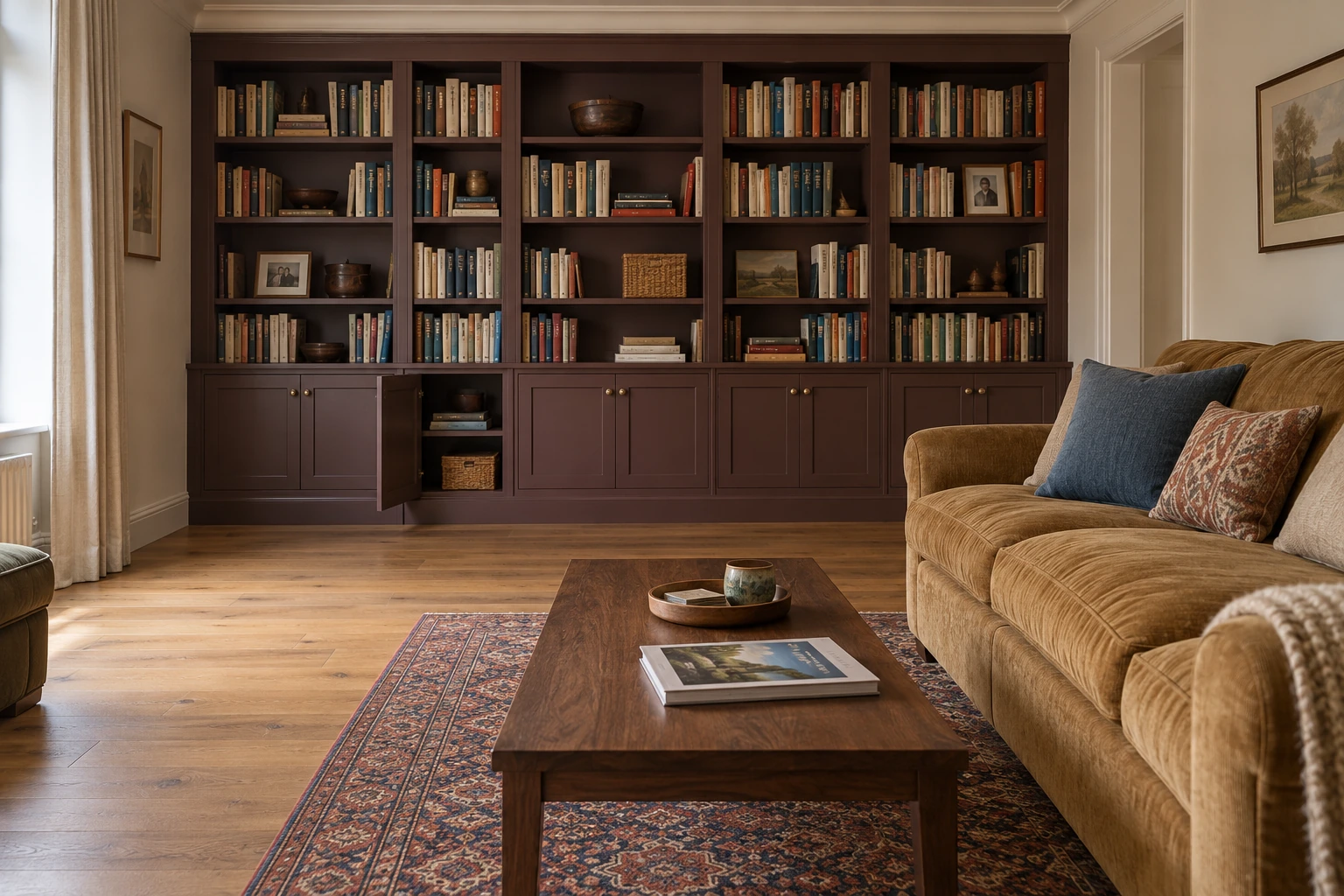
A rug can make a seating group feel settled—or make every piece look as though it has drifted away from the others. The useful question is not simply “What size is my living room?” It is “Which pieces should this rug connect?”
Start with the sofa and chairs, then test the rug’s outline on the floor. Once that relationship works, consider texture, cleaning and the cost of the rug together with its pad. A beautiful pattern cannot make up for a corner that catches the door or an edge that stops just short of the seats.
The images in this guide are Maison Matière interior concepts. The measured drawings are hypothetical planning studies; they do not document a real home or depict the products in the shopping edit.
Measure the seating group before the room
Record the sofa’s overall width, where its front feet land and the furthest point reached by the chairs you want to include. A chair angled towards a sofa can occupy more floor than its advertised width suggests. Include the position it takes when someone actually sits in it.
Next, decide what the rug is doing. In a compact room it may connect the front of the sofa to one chair. In a larger conversation area it may contain the entire furniture group. A separate reading nook can have its own rug without joining every piece in the room.

A rug needs to be judged from the room’s entrances as well as the main seat. If you are still deciding where the furniture belongs, use our awkward living-room layout studies first. Moving a chair after ordering can change the size you need.
6 × 9, 8 × 10 or 9 × 12 feet? Compare the same arrangement
These three drawings keep the room and furniture fixed. The hypothetical room is 12 × 14 feet (about 3.66 × 4.27 metres), with an 84-inch-wide sofa and a side chair. Only the rug changes, so you can see the relationship rather than compare three differently styled photographs.
6 × 9 feet: enough for a smaller group, too little for this one
6 × 9 ft rug
- 1 · Sofa
- 2 · Chair
- 3 · Table
The sofa feet remain outside the rug.
Here, the rug sits in front of the sofa rather than beneath its front feet. The table has a surface beneath it, but the sofa and side chair do not read as one group. This is a reason to reconsider the size, not proof that every 6 × 9-foot rug is too small.
That size—approximately 1.83 × 2.74 metres—can work around a loveseat, in a small reading area or in a room where a larger outline cannot fit. Test it with your own furniture rather than rejecting it because of the label “living room.”
8 × 10 feet: a front-legs-on arrangement
8 × 10 ft rug
- 1 · Sofa
- 2 · Chair
- 3 · Table
The front feet connect the seating to the rug.
The larger outline now reaches beneath the sofa’s front feet and includes the chair. Some timber floor remains visible around the group. For this particular arrangement, it connects the pieces while keeping the sofa’s back feet outside the rug.
An 8 × 10-foot rug is approximately 2.44 × 3.05 metres. It is a useful candidate to tape out, but not a default answer for every medium-sized room. A very wide sofa, a second chair or a different orientation may need more width.
9 × 12 feet: the furniture sits within the rug
9 × 12 ft rug
- 1 · Sofa
- 2 · Chair
- 3 · Table
All seating feet sit on the rug in this example.
The 9 × 12-foot outline—approximately 2.74 × 3.66 metres—contains the sofa and chair in this study. The larger textile field becomes a stronger part of the room’s composition and leaves a smaller border of exposed floor.
It also means buying, moving and maintaining more material. Before choosing it, check doors, heating outlets and how much floor you want to see. More rug is helpful when it makes the group work; buying the largest possible size is not the aim.
A 6 × 9 ft rug—about 1.83 × 2.74 m—is a useful size to mark out around a loveseat or a smaller seating group. Check which feet it actually reaches before deciding that it fits.
If you want to connect the sofa’s front feet with a nearby chair, try an 8 × 10 ft outline, approximately 2.44 × 3.05 m. Move the chair into its usual position while you check it.
For a wider conversation group, or one you want to contain completely, test 9 × 12 ft, about 2.74 × 3.66 m. These are starting points for your furniture, rather than sizes prescribed by the room’s name.
With a sectional, follow the whole seating shape
Check the chaise as well as the sofa
- 1 · Sofa
- 2 · Chaise
- 3 · Table
A chaise changes the group’s depth. Measure its outer end as well as the sofa’s width, then position the candidate rug so that the front feet of the main sofa and the chaise’s supporting feet have a coherent relationship with it. Avoid solving one side while leaving the other perched on an edge.
In this separate study, an 8 × 10-foot rug extends beneath the front of a 96-inch-wide sectional and the end of its 60-inch-deep chaise. The back of the sectional remains outside the rug. The arrangement is one possible solution; a deeper sectional or a chair added opposite may change it.
For a compact room with a television, compare the seating trade-offs in our three small living-room TV layouts. A rug should support the layout you choose, not persuade you to keep an oversized chaise.
Choose construction for the way you live
“Wool,” “flatweave” and “washable” describe different things: a fibre, a construction and a care claim. A wool rug can be flatwoven; a washable rug can have a thicker pile. Read the fibre content, construction, thickness and care label separately.
Wool: choose the texture, then investigate the care

A wool surface can add a substantial, tactile layer to a room with smooth furniture. Compare a sample against the sofa fabric and floor rather than choosing from a screen alone. The variation in yarn may be the feature you enjoy most.
Check whether the rug is entirely wool or a blend, what the second fibre contributes, and whether the construction is suitable for your vacuum and daily use. Some wool rugs shed, especially initially; a low-maintenance expectation needs to be checked against that specific rug’s guidance. Professional cleaning may also belong in the long-term budget.
Flatweave: a thinner-looking layer with its own compromises

The woven surface and edge can create a crisp, graphic effect beside upholstered seating. Lower thickness may help where doors or movable furniture are a concern, but “flatweave” alone does not establish the finished height: a textured surface and a pad add to it.
Look for information about grip, edge movement and the recommended pad. Decide whether you prefer the visual clarity of a flatter textile or the softer-looking surface of a pile rug. Neither appearance tells you that a rug is machine washable.
Washable: check the whole cleaning process

If cleaning at home is your priority, begin with the manufacturer’s instructions for the size you need. Check washing-machine capacity, drying method and whether the construction includes a separate base or pad. A large rug that cannot fit your machine may need a different cleaning arrangement.
The detail above illustrates a flexible, low-profile construction; it does not demonstrate washing performance. “Washable” should come from the product’s care instructions, not from how thin a rug looks in a photograph.
For help balancing rug texture with wood, upholstery and stone, see our guide to organic modern materials. You can use those material relationships in a colourful or more graphic room, too.
Check the pad, door and exposed edges together
Keep the pad beneath the rug
- 1 · Rug
- 2 · Pad
Check the combined thickness, floor compatibility and the supplier’s trimming instructions.
The rug and pad form one assembly. Confirm that the pad is approved for the rug and your floor finish, then check their combined thickness beneath any opening door. Some pad materials require particular floor-care conditions; the floor and pad manufacturers’ guidance should settle that decision.
The pad should sit beneath the rug rather than show around it. Our cutaway illustrates that relationship, not a universal trimming dimension. Follow the pad supplier’s instructions, and check that the rug’s perimeter lies flat after installation.
In a narrow room, keep the main walking route legible and avoid placing an unstable rug edge exactly where people turn. If an irregular room makes a standard rectangle awkward, revisit the furniture group before assuming you need a custom rug.
A focused rug edit for US shoppers
These are starting points for comparing real specifications, not hands-on product reviews. The links are ordinary retailer links and currently earn us no commission. Listings were checked on 4 October 2026; confirm the selected size, composition, care instructions and total price before ordering.
Before you order: five decisions to settle
- Outline: tape the actual dimensions on your floor, including any fringe stated separately.
- Furniture contact: decide which feet sit on the rug and check that the arrangement is stable.
- Daily use: open doors and move chairs through their normal range.
- Care: read fibre content and cleaning instructions for the exact size and construction.
- Total purchase: include a compatible pad, delivery, return conditions and any cleaning requirements.
Then finish the room around that decision: compare compact furniture choices and lighting that preserves useful space. The rug, seating and lighting work best as one arrangement.
Two common living-room rug questions
Does every furniture leg need to be on the rug?
No. A deliberate front-legs-on arrangement can connect a sofa and chairs while leaving their back feet outside. Check the furniture’s stability and how the whole group reads; a rug that only reaches the coffee table may feel disconnected in some arrangements.
Should I choose the size from the room dimensions alone?
Use the room dimensions to check the boundary, then use the furniture group to choose the outline. The same room can need different rug sizes with a loveseat, a sectional or two facing sofas.
Sources and editorial notes
The planning comparisons and diagrams are original Maison Matière studies. They use stated hypothetical dimensions and are not accessibility standards, measured client projects or representations of the shopping products.
- Crate & Barrel: choosing a rug—furniture relationships and testing a rug outline.
- Rugs USA: rug-pad guidance and general rug care; individual care labels take precedence.
- Composition and thickness figures in the shopping edit come from the linked retailer listings, checked 4 October 2026.
Read our editorial standards and shopping disclosures, or explore more living-room guides.
Start with one change, photograph the room and check how it feels in daily use before adding another.