
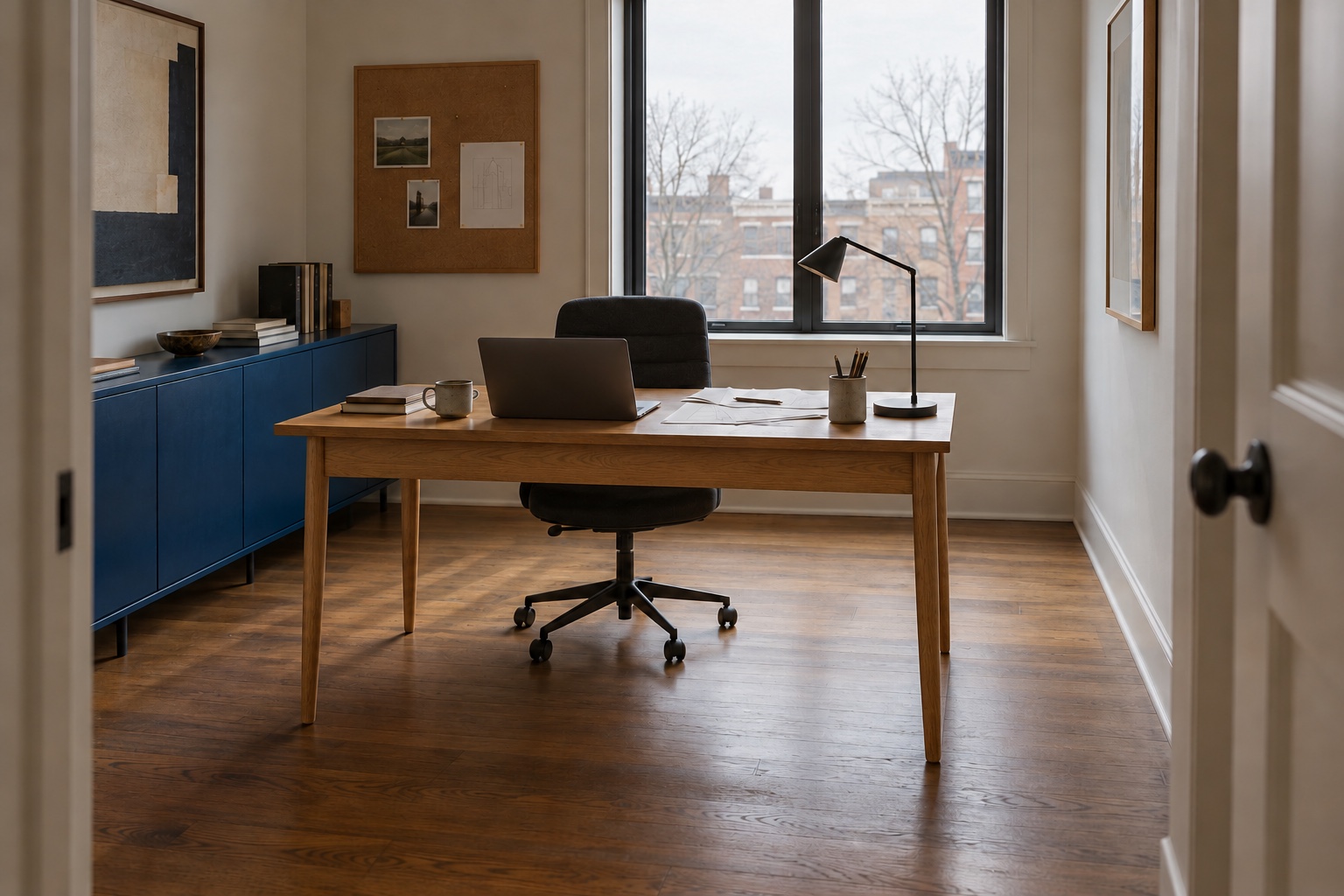
Style notes / Mid-century modern
Mid-Century Modern Interior Design: More Than the Furniture
Make the style work for a real room through furniture scale, clear routes, useful light and materials with character.

Find your design language
Spot the differences, find the details you love, and bring them together in a home that feels like you.
New stories
Style notes / Mid-century modern
Make the style work for a real room through furniture scale, clear routes, useful light and materials with character.
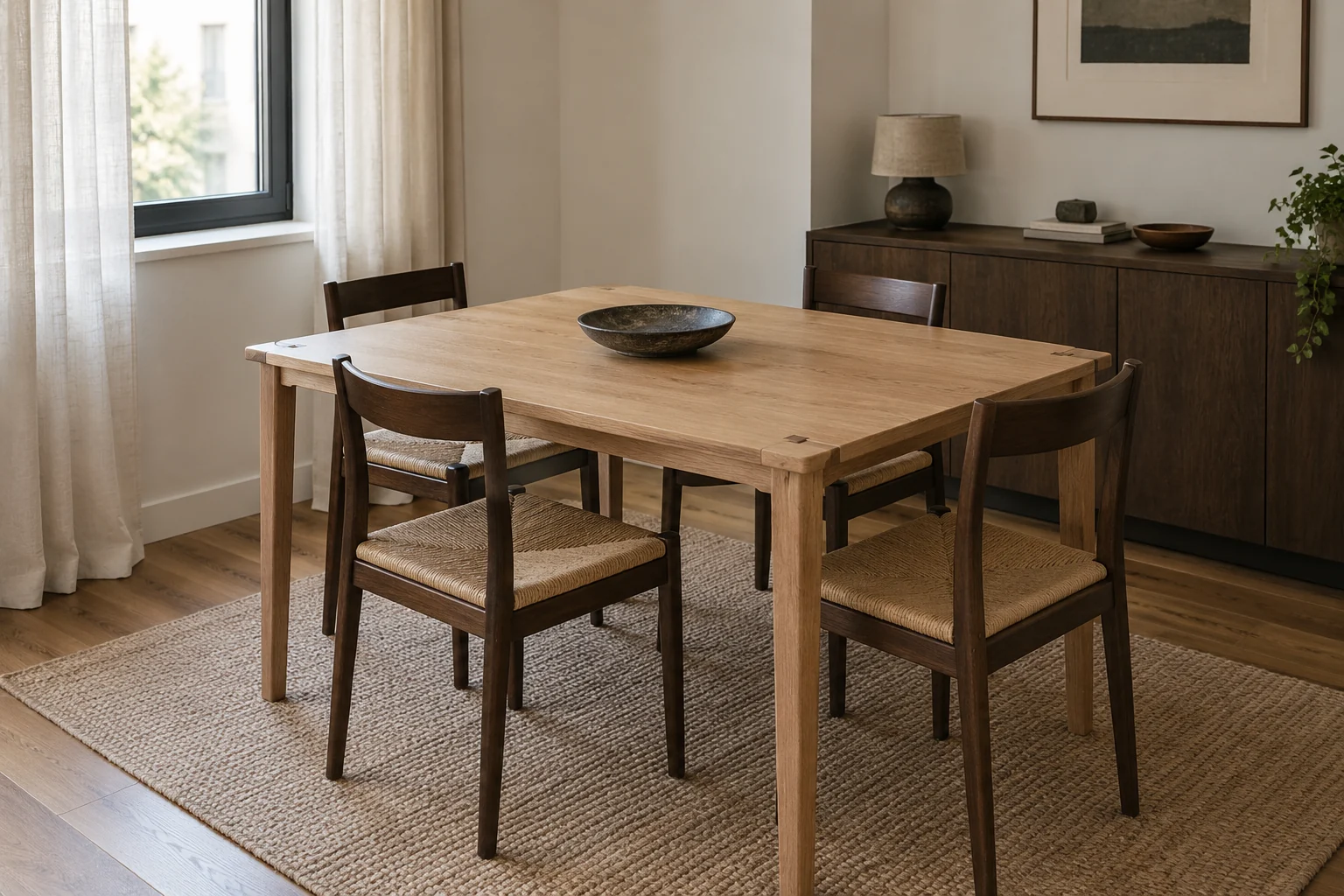
Style notes / Japandi
Color, furniture and everyday details that make a quieter home feel like yours.
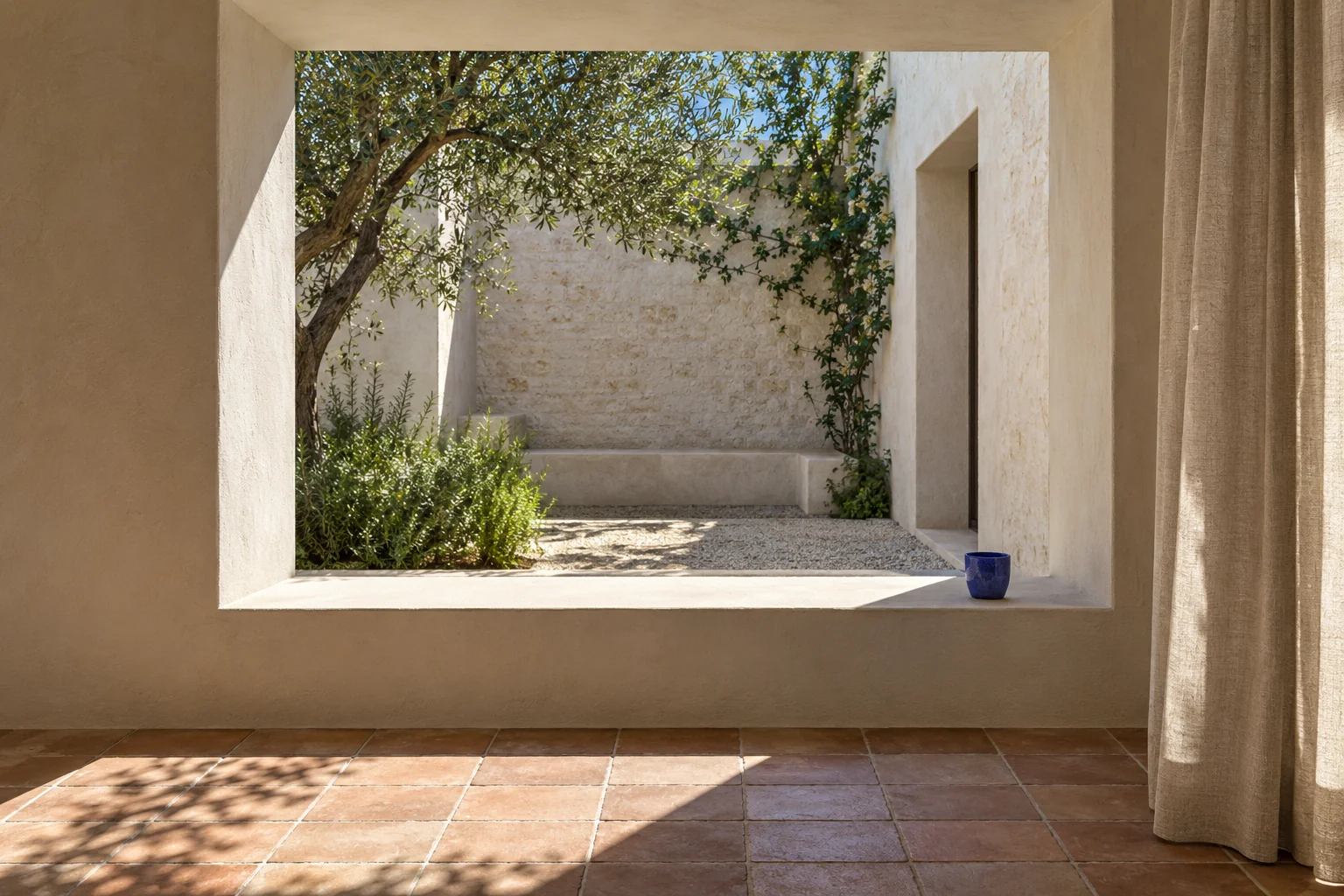
Style guide / Modern Mediterranean
Bring light, linen, clay and useful material relationships into a courtyard home or a city apartment, with considered finish and shopping decisions.

Modern, seen through its furniture: the exposed chair frame and long cabinet give the room clear lines; leather and wood add warmth.
Thin frame · Horizontal cabinet · Useful seating group
To recognise an interior design style, look at the furniture shapes, the materials and how much space sits between them. Colour helps, but a beige sofa can belong to several very different rooms.
You might save a spare, sunlit dining room one day and a snug, book-filled sitting room the next. That doesn’t mean your taste is confused. It means you’re noticing different things: the quiet of one room, the warmth of another, perhaps a particularly good chair.
This visual guide looks at eight interior design styles and the choices that give each its character. Use it to put words to what you like, then borrow the parts that suit your own home. There is no need to dress every room in the same uniform.
When a room catches your eye, cover the caption for a moment. What are you actually responding to?
Follow the outline of the largest pieces. A slender chair that shows its frame creates a different impression from a deep sofa that sits close to the floor. Then look at the surfaces: polished metal, worn wood and woven fabric each catch light differently. Finally, notice the empty spaces, the pattern and the objects left on display.
Try finishing this sentence: “I like the ___, but I could happily lose the ___.” “I like the low furniture, but I could lose the bare walls” is more useful than deciding you must be a minimalist. It gives you something to work with.
Modern, contemporary, mid-century modern, minimalist, organic modern, Japandi, modern rustic and modern Mediterranean are useful starting points. There is no single official list of seven or ten styles; labels overlap, and different publications group them differently.
Modern rooms are easy to recognize in clear geometry and exposed furniture frames. Wood, leather, steel and glass can all belong here. Keep the pieces useful and give their outlines room to show.
Contemporary is a mix that reflects the present, so it can change over time. Varied or contrasting finishes work more clearly when one piece leads the room.
A shaped chair back or slender timber support often gives mid-century modern its character. Look at the construction and outline alongside the upholstery or molded material; a retro color alone says less.
Minimalist rooms rely on simple volumes, clear space and a restrained set of finishes. The practical work happens in the storage: everyday things need somewhere to go if the room is to stay calm.
Organic modern softens contemporary forms with wood, stone and woven fabric. A little contrast and tactile variation can give the room depth without adding another collection of objects.
In Japandi, restrained shapes draw attention to craft. Notice the joints, proportions and usefulness of wood furniture, woven seats, cloth and ceramics.
Modern rustic puts plain shapes beside more irregular surfaces: worn wood, stone, metal or wool. Give an aged material a quieter neighbor so its marks remain easy to appreciate.
Modern Mediterranean brings relaxed forms together with mineral finishes, clay, linen and wood. Adapt the materials and control of daylight to the home you have.
These are clues to recognise, not ingredients every room must contain. Follow a style name for the example below.
Modern refers to a design tradition; contemporary describes work of the present. Modernism developed through several twentieth-century movements, with an emphasis on function, new ways of making things and less applied ornament. The V&A’s introduction to Modernism is a useful grounding in those ideas.
In a modern interior, you might notice a low horizontal cabinet, an exposed steel chair frame or a clean, geometric table. Look back at our opening room: the chair’s thin frame is doing as much visual work as its colour. The wood and leather stop that clarity from feeling chilly.
Contemporary interiors can draw on several periods. Their defining reference is the present, so the term changes over time. Designers interviewed in AD’s guide to contemporary interiors make this distinction too. A rounded sofa beside a brushed-metal table is one possible expression, rather than a compulsory contemporary formula.

A contemporary pairing: soft upholstery meets a reflective metal surface. The colour and curve give this corner character without extra ornament.
Rounded volume · Metal contrast · Restrained display
At home, try choosing one clear shape to lead: perhaps a straight-lined sofa with a softer chair, or a generous curved sofa beside a very simple table. If every piece demands attention, even a lovely room can feel like a conversation where everyone is talking at once.
Mid-century modern belongs within the broader modern story. Furniture from the middle decades of the twentieth century often combines practical construction with expressive shapes: tapered supports, curved backs, low cabinets and a sense of lightness around the floor.
Wood is only part of the picture. Designers also explored moulded plywood, metal and other materials. Charles and Ray Eames’s 1946 DCW chair in MoMA’s collection shows how shaping plywood could bring structure and comfort together. Our illustration below is an original concept, not that museum piece.
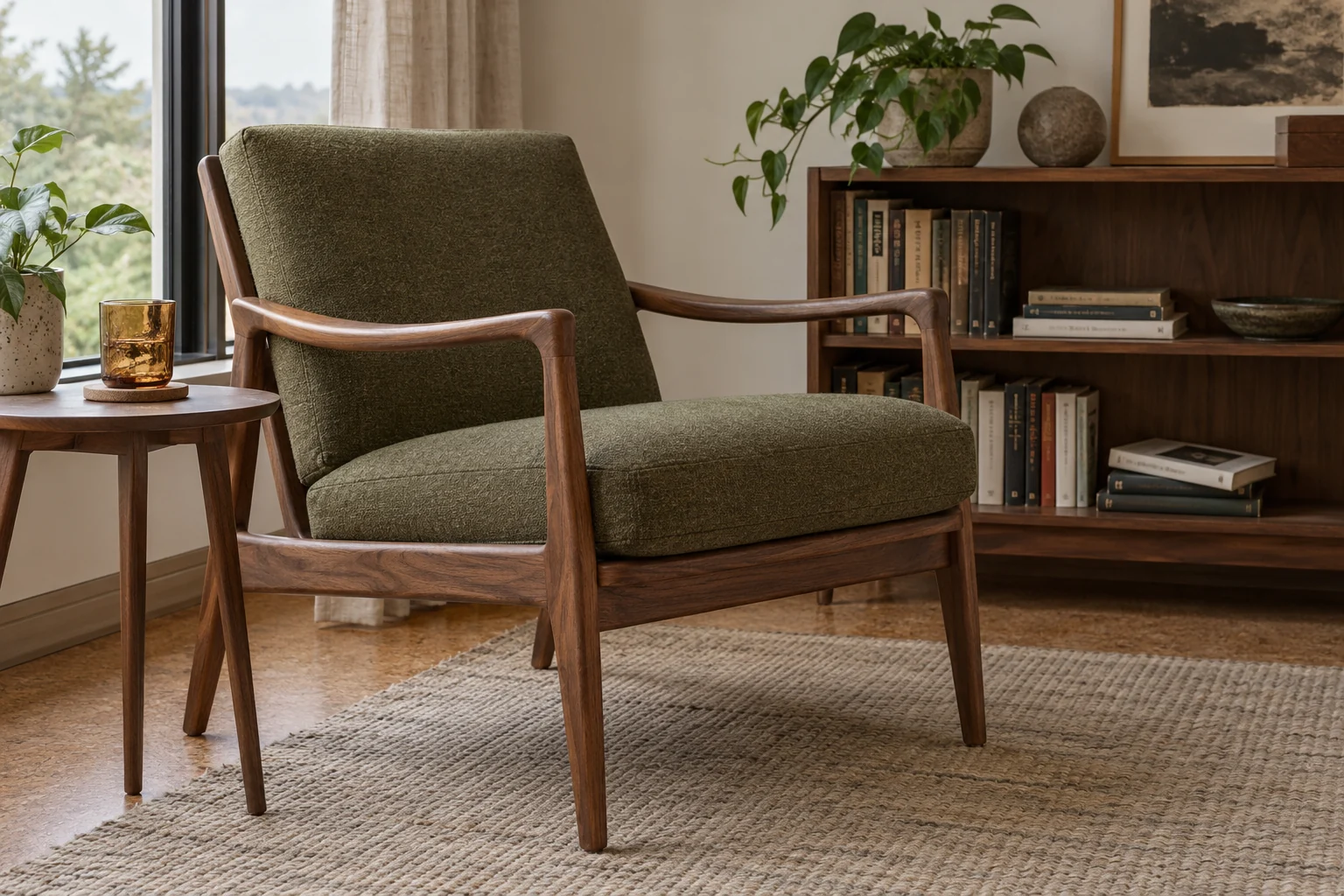
Look at the open frame, the shaped arm and the space beneath the seat. Those details carry the mid-century influence more clearly than a retro colour scheme.
Visible frame · Shaped arm · Light-looking supports
A chair with a visible timber frame can bring this character into a room without a full retro makeover. Pair it with the sofa you already own and repeat its wood tone somewhere small. You don’t need the matching cabinet, matching lamp and matching everything else.
For practical decisions about furniture scale, circulation, color and useful light, see our mid-century modern interior design guide.
If buying vintage, sit in the piece, inspect joints and ask about repairs. A good silhouette is still expected to hold a person.
Minimalist interiors reduce visual noise through simple forms, a limited set of finishes and carefully chosen objects. That can mean pale walls and bare floorboards, but neither is a requirement. A dark room can be restrained too.

The quiet look has practical support: closed storage, a bedside surface and a light beside each pillow. The everyday objects have somewhere to go.
Closed storage · Clear surfaces · Reachable light
The useful question is what happens after the photograph. Where do the charger, spare blanket and half-read book go? Closed storage and a reachable light do more for a calm bedroom than removing its bedside table and hoping for the best.
Start by clearing one surface and finding a home for what you removed. Keep the things you enjoy using. For a compact room, our small-bedroom ideas help you think about the bed, storage and access together.
Both can be quiet, tactile and uncluttered. The useful distinction is their emphasis: organic modern often softens contemporary furniture with natural surfaces and rounded forms; Japandi brings together Japanese and Scandinavian design influences, with particular attention to restraint, craft and everyday usefulness.
These are broad contemporary labels. An oak table or a linen curtain cannot settle the question on its own, and neither label describes the full range of Japanese or Scandinavian design.
Think about the relationship between surfaces. A rounded upholstered sofa might sit beside a smooth wood table, with a stone surround or a woven rug adding a different feel. The furniture stays straightforward while the materials provide interest.

The rounded sofa and table provide softness; the dark cushion separates the pale textiles from one another. The surfaces vary without each becoming a focal point.
Soft outlines · Natural surfaces · Dark accent
It works better when everything isn’t the same pale shade and texture. A charcoal cushion or darker ceramic bowl can give the softer finishes some definition. Our organic modern guide explores those material and colour relationships in more detail.
Look for pieces whose joinery, proportions and everyday purpose are easy to appreciate. In the dining example, a pale table and dark woven-seat chairs create enough contrast without filling the tabletop with decoration.
Pale and dark timber distinguish the table from the chairs. The visible construction and mostly clear tabletop make this a useful example of restrained, craft-focused furnishing.
Visible joinery · Woven seats · Clear tabletop
The shared interest in craft and materials has deeper roots than a recent decorating label. Fritz Hansen’s discussion with Nendo’s Oki Sato explores that connection between Danish and Japanese design.
You can borrow the restraint without buying low furniture that is uncomfortable for you, or treating Japanese culture as a collection of decorative motifs. Try leaving the table mostly clear, improving the light and choosing a chair you actually enjoy sitting in.
Explore our Japandi interiors guide for color combinations and small changes to living, dining and bedroom furniture.
Modern rustic puts the irregularity of aged wood, stone or woven fibres beside simpler contemporary shapes. The appeal is in the pairing: a characterful surface gets enough quiet around it to be noticed.

A worn wood surface meets a plain metal support. That change in texture is the point; every neighbouring piece need not look aged.
Weathered surface · Simple support · Quiet neighbour
If you have an old dining table, try it with plain chairs before deciding the whole room needs to look country. Conversely, a room full of new furniture may only need one piece with a less perfect surface. When the timber, rug, wall and accessories all compete with heavy texture, the effect can become busy quickly.
Scale matters too. A chunky table can consume a narrow room even when its colours are gentle. Our modern rustic guide looks at material pairings and furniture depth together.
Modern Mediterranean interiors draw on a wide and varied region, so one white wall and an arch are not a definition. For a contemporary interpretation, consider how pale mineral finishes, clay, woven cloth and wood respond to daylight.

Light reveals the linen weave and softens the window. Check privacy and glare separately before choosing a sheer as your only covering.
Filtered daylight · Woven cloth · Pale mineral surface
A linen curtain is an especially useful example: you can see its weave, the softness of its folds and the light passing through it. But a pretty sheer may not provide the privacy or glare control your window needs. The practical layer matters as much as the atmosphere.
In a city apartment, you might borrow the cloth, a clay lamp or a warm wood finish while keeping your existing windows and layout. There’s no need to pretend the view outside is a courtyard. See our modern Mediterranean guide for more ways to adapt the idea to the home you have.
Traditional often describes rooms with familiar historic furniture shapes, pattern, antiques and balanced arrangements. Transitional usually softens that formality with simpler upholstery and cleaner outlines. These are broad decorating terms, not exact historical periods.
Scandinavian is another wide family, rather than a synonym for white walls. Useful furniture, careful woodwork and comfortable light are helpful clues. Eclectic describes a deliberate mix: different eras or influences connected by something such as colour, shape or scale.
You can recognise more than one of these in the same room. A vintage cabinet doesn’t cancel a contemporary sofa.
Yes. Start with the pieces you want to keep, then give the mix one or two visible connections. Repeating a wood tone, a curve or a colour lets different furniture feel related without looking like a set.
Say you own a square-armed gray sofa and inherit a curvy dark-wood chair. A small dark-wood table can connect the chair to the seating group; a cushion with some of the sofa’s gray can link them again. You can keep the chair’s personality without making everything else antique.
Avoid trying to balance styles by a fixed percentage. The biggest piece, the brightest colour and the strongest pattern will each carry different weight. Stand in the doorway and see what you notice first. If it is the object you like least, that is a useful place to begin.
For colour connections, try our nature-inspired palettes. If the mix looks good but feels awkward to move through, check the living-room layout before buying more pieces to fix it.
A slim frame can reveal more floor, but it doesn’t make an oversized chair smaller. Check the overall width and depth, how doors open, and where people walk. One comfortable sofa may serve you better than several little chairs added to complete a particular look. Our small-space furniture guide compares those choices.
There isn’t an objective winner. A room is more likely to stay useful to you when its furniture fits, its materials suit daily life and its choices reflect things you continue to enjoy. Buying a whole trend at once makes it harder to change one part later.
Keep the expensive decisions tied to comfort and function. Let a shade, cushion, artwork or small secondhand find carry an experiment. You can change your mind about burgundy without replacing the sofa.
Then test a change that costs nothing: move the lamp, clear a crowded shelf or bring a chair in from another room. Live with it before adding anything new.
If a purchase would help, work out the dimensions and job before searching for a style label. Our small-room lighting guide and living-room rug guide are good next stops. The right room is the one you want to come home to, including on an ordinary Tuesday.
See these ideas in context through our room collections, look closely at materials and finishes, or continue into the room and style shopping edits.

Style guide / Modern rustic
Pair aged timber, stone and woven surfaces with useful contemporary furniture. Explore four rooms, material details and a measured table study.

Style guide / Organic modern
Simple forms, tactile materials and a palette with depth. Build an organic modern room around the furniture and routines you already have.
You can love a spare, sculptural room and still want to keep your grandmother’s cabinet. Interior design styles give you a way to describe what catches your eye, but a home rarely needs to follow one label from floor to ceiling. Look at the shapes, textures and use of light before worrying about what to call the result.
Our organic modern guide explores simple forms with tactile materials. Modern rustic interiors give weathered surfaces a place beside cleaner lines, while modern Mediterranean design looks at light, shade and finishes in their setting. The distinctions become more useful when you can see what each choice does in a room.
When mixing influences, choose something that connects them: a recurring wood tone, a similar curve or a color that appears in a few places. Then let one unexpected piece interrupt the pattern. A room with a little personal history is usually more interesting to look around.