


The most useful living room wall decor ideas begin with the room below the wall. A beautiful print can look lost above a long sofa; a mirror can reflect the busiest corner; a collection can feel scattered when every frame has its own spacing.
Before buying something to fill the gap, decide what the wall needs to do. Give the room a focal point? Bring in colour? Hold a collection? Reflect a view? These seven approaches help you choose the right kind of wall decor, then judge its scale and position.
Start with the furniture and the view.
Look at the wall from the doorway and from your main seat. Note the sofa, sideboard, window and TV as parts of one composition. If two features already compete for attention, a third large gesture may make the room less settled. It can be enough to finish one focal wall and leave another quiet.
Measure the furniture beneath the proposed display and the unobstructed wall area. Include switches, wall lights, vents and doors. Use paper templates to try the overall shape before ordering frames. Test the arrangement in real space, rather than relying only on a close-up photograph. If the seating still needs to move, work through the living room layout guide before fixing the display.
1. Use one large artwork for a clear focal point.
A single piece creates one visual boundary. It can be a useful choice above a sofa when the surrounding room already contains books, a patterned rug or several furniture shapes. Choose the work because you want to see it regularly, then select a frame that relates to the room.
For an initial scale test, Pottery Barn’s hanging guide suggests a display around two-thirds of the furniture width. Over an 84-inch sofa, that gives a starting outline of about 56 inches across, including the frame. This is a styling reference, not a required proportion. Try a wider and a narrower paper outline before deciding.
A smaller work does not become wrong because it misses that ratio. It may belong over a narrower cabinet or in a deliberately intimate reading corner. Let its location support its size instead of surrounding it with unrelated accessories to fill the wall.
If you want to illuminate the work, compare the picture light with the frame and the viewpoints in the room. Our guide to lighting artwork explains how aiming, coverage and reflections affect the result.
2. Hang a pair or a small series as one composition.
Two or three related works can give a long wall rhythm without the complexity of a larger gallery. Treat the outer edge of the whole arrangement as the display’s size. Measure frames and the spaces between them together.
Hold one relationship steady: the frame finish, a shared top edge, the subject or a repeated colour. The images can differ. A pair of equal frames often feels ordered; different frame sizes can work when the gap and shared alignment make the relationship legible.
Mock up the entire grouping, including the gaps. Buying three prints separately and judging each against the wall is how a coherent collection becomes too wide.
Judge the outline of the whole display
- One large artwork
- Judge the complete outer shape against the furniture below.
- Gallery wall
- Treat the related frames as one group; plan the outer boundary first.
- Shelf or ledge
- Include the full length, objects and fixing requirements.
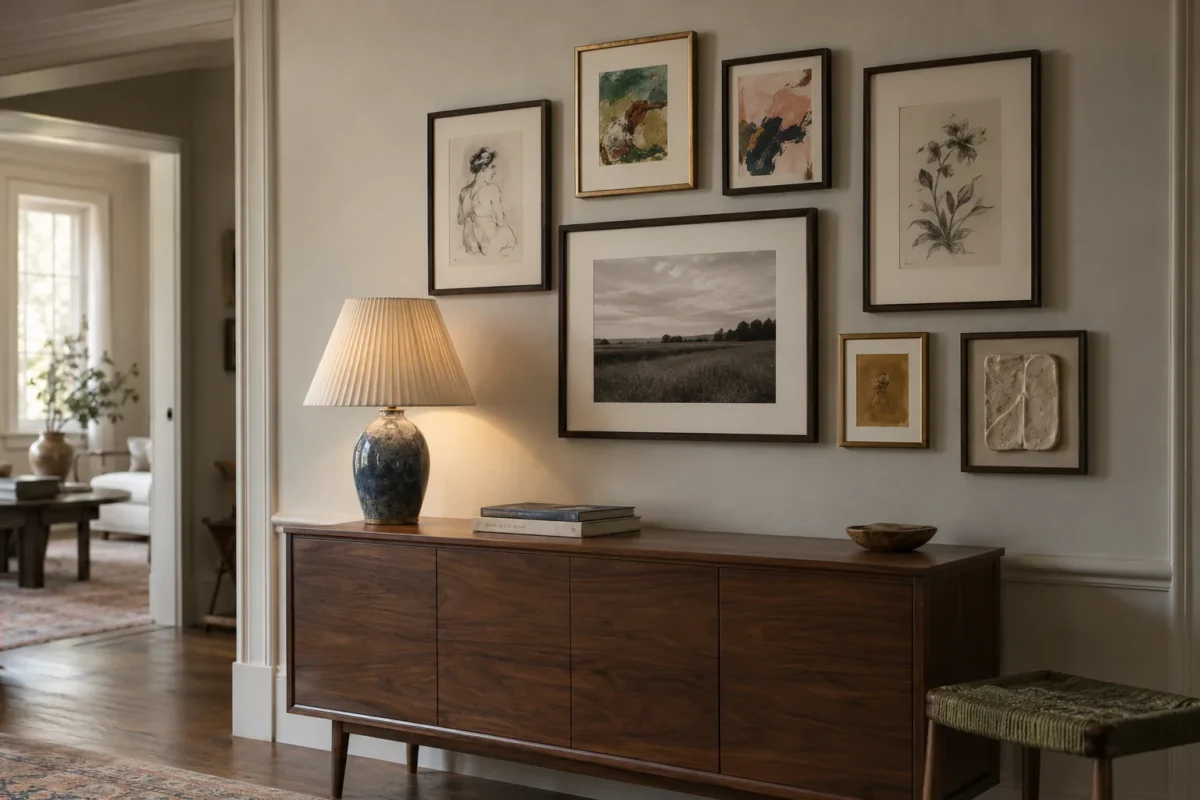
3. Build a gallery wall around a collection you care about.
A gallery wall makes sense when the collection is the point: family photographs, drawings, travel finds or prints gathered over time. Choose an anchor work first, then arrange the other pieces around it on the floor. Photograph the arrangement before moving it to the wall.
Use consistent spacing as an organising tool rather than matching every frame. For a neat grid, equal frame sizes and repeated gaps are useful. For a looser arrangement, keep the gaps reasonably related and check the outer outline. Avoid very tight corners in one area and large unexplained holes in another.
Decide whether the collection will grow. A complete rectangle feels intentional now, but leaves less room to add pieces later. A more flexible arrangement can extend toward one side; plan where that growth will go so it does not collide with a window or light.
4. Choose a mirror for what it reflects.
A mirror is both an object on the wall and another view of the room. Before fixing it, ask someone to hold a lightweight template or use a photograph to study the proposed position. Check the reflection from the sofa and the entrance, not just while standing directly in front of it.
A view of a window, a favourite artwork or an uncluttered corner can add interest. A reflected storage pile, exposed equipment or a bright lamp may do the opposite. The effect depends on position and light; a mirror does not automatically make every small room feel larger.
Compare the weight, hanging orientation and required fixing system before buying. Follow the maker’s instructions and use fixings suitable for the wall construction. A heavy mirror above seating needs a secure installation, not a styling shortcut.
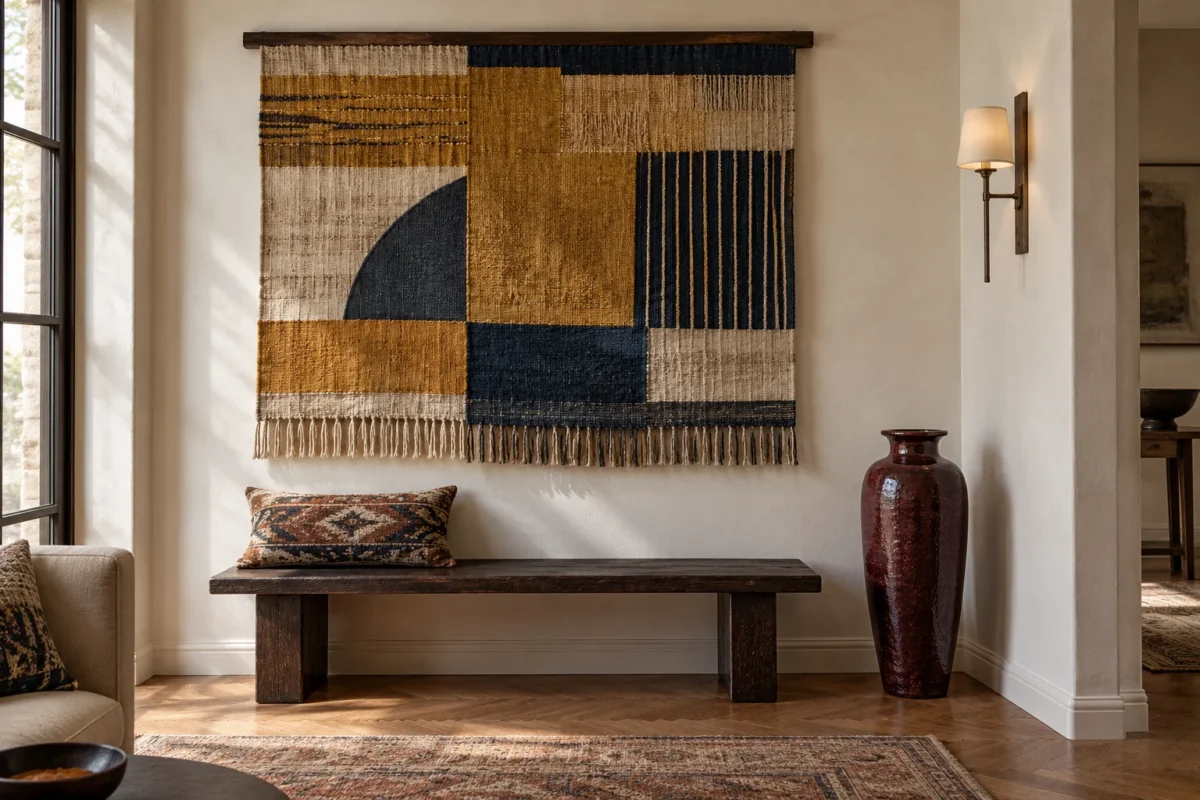
5. Bring softness with a wall textile.
A woven hanging, quilt or other textile can introduce a large area of texture without the hard outline of glazed art. It can suit a room with several smooth surfaces: glass, metal, a plain painted wall and a tightly upholstered sofa.
Check how the textile hangs as a full piece. A photograph of the weave will not reveal whether the corners curl or the fabric distorts under its own weight. Choose a support appropriate to the textile and leave it clear of heat sources. Its visual softness is a design effect; do not assume it provides a measurable acoustic improvement without product evidence.
For colour, borrow one tone from the rug or upholstery rather than matching every surface. A quiet textile can add depth to an organic modern living room without turning the wall into another busy feature.
6. Use a picture ledge when the display changes often.
A shallow ledge can make it easier to change the arrangement of smaller frames without creating a new set of holes for every work. Think of it as a display surface, not an invitation to cover every inch.
Start with one anchor piece, then add a smaller work or object at a different height. Check the overlap so an important part of an image is not hidden. Leave a clear section of shelf to keep the display readable.
Measure the ledge’s projection and keep it clear of heads, door swings and walking routes. Check its load limit and installation instructions, including the weight of every frame placed on it. A location beside a chair or above a sideboard may be more practical than directly above a heavily used sofa.
7. Let wall colour be the decoration.
Sometimes the room needs a different background more than another object. A painted wall can connect a seating group, make a light frame stand out or give a plain cabinet a deliberate setting. Test a large sample in daylight and after dark before painting the whole surface.
Decide where the colour starts and stops. An existing wall feature can make the choice feel clear. A small floating painted shape behind a small artwork may add two competing outlines instead of solving the scale problem.
If you rent, check what changes are permitted and what restoration will involve. You can also get a similar colour relationship from a larger artwork or removable textile. Our nature-inspired palette guide shows combinations beyond a single accent colour.
How high should living room wall decor hang?
For a standalone artwork, Pottery Barn uses roughly 60 inches / 152 cm from the floor to the centre as an eye-level starting point. Above furniture, judge the relationship to the sofa or cabinet as well as the whole wall. Do not force one eye-level number if it makes the work feel detached from the furniture or puts it in the way of people using the seat. See the source’s hanging examples.
Use paper templates to compare two heights. Sit down, stand in the entrance and look from the side. Check head clearance for shelves or projecting frames, and confirm the fixing method before drilling. Leave nearby switches and outlets usable.
For multiple works, judge the centre and edges of the grouping, rather than positioning every individual image at the same centre height. Keep the spacing that made the arrangement work on the floor.
A focused US sourcing edit.
Choose the approach first, then shop within its dimensions. These are ordinary retailer links with no current commission to Maison Matière. They are places to compare, not tested recommendations or the exact pieces in our concept image.
Two common wall decor questions.
Should every living room wall have something on it?
No. A quieter wall can help a collection, a view or the main artwork become more noticeable. Finish the wall that matters from your usual seats, then decide whether the others need anything.
How do you decorate the wall around a TV?
Start with the screen, storage and cable route. Add art only if you want to see that arrangement when the TV is off; the screen does not need a surrounding gallery to justify its presence. Check viewing comfort and glare in our small living room with a TV guide.
Before your next purchase, mark out one complete display and leave it in place for a day. A useful living room wall decor idea should improve the composition from everyday viewpoints, not just fill an empty patch.
Keep exploring curtain ideas for the living room, awkward room layouts and the living room index.
Sources and editorial notes.
Hanging references and retailer categories were checked on 3 October 2026. Numeric styling starting points are attributed to Pottery Barn; the diagram is an original Maison Matière composition study, not a measured installation or fixing specification. The room and detail images are Maison Matière interior concepts. No product testing or sponsorship is claimed.
Start with one change, photograph the room and check how it feels in daily use before adding another.


